

Sign up for our free monthly news and story alerts |
CITY GUIDE Phnom Penh, strictly slow lanePhnom Penh business hotels and some chic boutique inns. Plus a list, albeit a short one, of things to do in Cambodia’s modestly boisterous capital.   SEE ALSO Angkor Guide | Laos | Hanoi Guide | Vietnam Beach Resorts | Bangkok Hotels 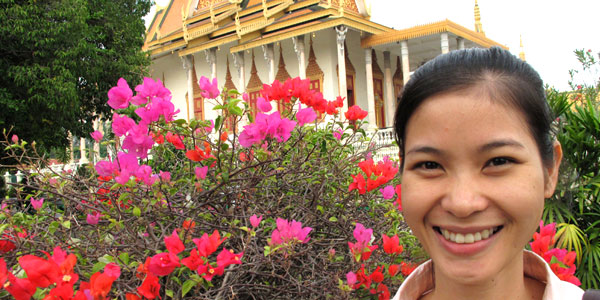
Bougainvillea blossoms add a huge splash of colour to the Royal Palace grounds/ photo: Vijay Verghese JUMP TO Getting around Phnom Penh | Temples, pagodas and museum | Shopping and fun | Nightlife in Phnom Penh | Business hotels | Boutique hotels | Hotel Contacts AT FIRST glance, Phnom Penh doesn’t seem much at all. It barely registers as the plane swoops down through the morning haze, over flat farmland, the lazy-python meanders of the chocolate Mekong heavily gorged on silt, and a few ribbons of dusty road. This unremarkable bucolic scene is not what you’d expect of an Asian capital. It’s no Bangkok or Manila. There’s no traffic to speak of. In fact, traffic lights are a rarity. The odd elephant lumbers down the quay along with zinging two-wheelers and the occasional muscle SUV with mysteriously tinted windows and official number plates, always escorted by a motorcycle outrider, siren wailing. As the sirens fade it’s back to the ghetto blasters and an oddly engaging riverfront ritual, dusk and dawn, where ragtag groups perform a desultory, synchronised dance, almost zombie like, some wandering away with shy smiles halfway through the routine. Children giggle. Grandfathers gape. This is aerobics, Cambodia-style. And that’s when it hits you. This is a bucolic scene, one fast disappearing from the region. Sans-highrises (though this is changing), dusty, laid back Phnom Penh, with its endearingly tiny shoebox airport, is steeped in history, some of it brutal, much of it remarkable. It is a lingering look back in time. Get there before the concrete. More information at Tourism Cambodia (www.facebook.com and www.tourismcambodia.com/).
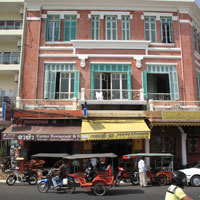
Old building on Sisowath Quay But why would anyone visit? Pondering just that for our Phnom Penh guide, I stepped out bright and early onto sleepy Sisowath Quay that runs along the Tonle Sap River (just before it merges with the Mekong), to stroll past bars, dishevelled restaurants, proud and peeling colonial corner buildings, and seedy establishments that had appeared far more self-assured in the dark of the night before with a daub of neon and lipstick. Orange-robed monks awaiting alms did their rounds, stopping prayerfully outside the better off establishments thronged with red-faced Europeans. As I snapped one shaven supplicant, a beefy Westerner of uncertain provenance burst from the bar, blinking in the harsh light, a mug of beer clutched in one hand, though it was barely 10am. “Yeah, you can take a picture of me,” he said, or rather, demanded. “Here?” I asked. “Sure, and then I’ll punch you right in the middle of your effing face.” “Right.” It was time to move on, back in time. So why would anyone visit? Phnom Penh International Airport is a grand name for a small dolls’ house facility that has just a handful of gates with air bridges. Modernity has arrived, but not overwhelmingly so. Visas on arrival (US$20) are studiously dealt with by courteous staff and, minus this small distraction, you can be through from aeroplane gate to taxi in five minutes if not waiting for baggage. Departing international travellers pay a US$25 passenger service charge while the domestic flight levy is US$6. Those intent on duty-free shopping in Phnom Penh can peel their eyebrows from the ceiling perusing Tokyo prices – US$44 or more for a one-litre bottle of duty-free Johnnie Walker Black Label. A BVLGARI Rose Essentielle 50ml eau de parfum is US$80 odd. Welcome to Cambodia. Send us your Feedback / Letter to the Editor Getting around the city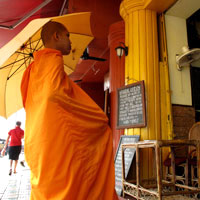
Monks seek alms Step outside to flag a metered taxi or hone your negotiating skills to bag a ride into town – just six kilometres and 20 minutes away – for around US$9, or less if you have a convincing kerbside manner. There are also cheaper tuk tuk motorcycle cabs seating from four persons to an entire planeload plus a packet of chips depending on the disposition of the driver and passengers. The intrepid and tight of wallet can head down the pecking order to contract a sputtering two-wheeler but, in either case, be prepared to inhale vast quantities of dust. Sitting in a tuk tuk while you choke would appear the more dignified approach to an unscheduled call on your Maker. The same ride in reverse, this time in air-conditioned luxury, can shoot up to US$20 in a hotel limousine. A pootle around town in a tuk tuk is in the range of US$2-$3 (or US$10 for the better part of the day), while pedal-powered cyclos are entirely dependant on whim, time, and the height of the sun, which can be punishing midday in summer. As any Phnom Penh guide will remind you, this is not a vast city and much of it, especially along the river, can be easily navigated on foot. You’ll get about a kilo of Cambodian riels for a dollar, officially US$1 = Crl4,080 but usually rounded off to around 4,000. Rather than carting sacks of local currency, carry lots of low denomination US dollar bills, which are universally accepted. You’ll get change in dollars too unless the amount is below a buck. With a population of just around 1.3 million, Phnom Penh makes a stab at something approaching soporific swagger Friday evenings but, for the most part, it has an unhurried, unworried pace, the traffic approaching intersections from all four sides at once and, miraculously, threading through without frequent mishap. The occasional fender-bender will invite a frown or a peevish shake of the head, but rarely police. Serene temples, pagodas, and a genocide museum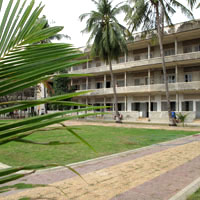
Deceptive calm of Tuol Sleng Despite its sleepy veneer, the town has a tough underbelly in parts and these areas are best avoided on foot late at night if you wish to enjoy uninterrupted ownership of your handbag, camera and wallet. One such spot is the seemingly innocuous leafy roundabout of Wat Phnom, the shrine that lends its name to the city, not far from the venerable Raffles Hotel Le Royal. Set on a small knoll, practically the only feature enlivening the otherwise flat topography of this plains town, by day the Wat presides over a lively and not unattractive park frequented by squealing schoolchildren, lovers, and gewgaw hawkers. One arm from this broad roundabout leads on to Sisowath Boulevard that turns to run north-to-south along the river while another, Norodom Boulevard, spikes off parallel to the river promenade directly through town and on to Independence Monument, a diminutive and simple burgundy structure, set within another large roundabout. The city blocks within the embrace of these two roads are where you will likely spend much of your time sightseeing and browsing. Conveniently for visitors, streets form a grid, not quite Manhattan-style, but easily understandable. It is hard to get lost. The streets running from north to south are odd numbered while the intermeshing east-west streets leading to the riverfront are even numbered, the value ascending as you move south down the quay from the Wat Phnom area to the Royal Palace. Addresses and house numbers can be pretty random however. Heading south along Sisowath you’ll pass Wat Ounalom Monastery before sighting the gilded spires of the Royal Palace on your right with its pale-yellow outer wall flanked on the north by the National Museum (www.cambodiamuseum.info), a handsome low-slung building in the traditional Khmer style dating back to 1920. 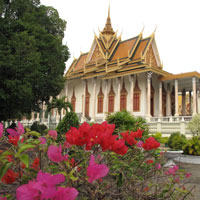
Silver Pagoda at the Royal Palace The Royal Palace has been home to Khmer kings since its construction in 1866, at which time Phnom Penh solidified its hold as permanent capital of Cambodia. Deep in the northern jungle fastness, Angkor had waned by the 15th century with the seat of power moving by turn to Phnom Penh and various other cities in the heartland. Over half the palace grounds are devoted to the royal residence, which is still in use and off limits to the public. Occupying the south of the complex is the Silver Pagoda or Wat Preah Keo housing its prized bejewelled and gold Buddha statues. Entry tickets for foreigners are Crl25,000 while Cambodians pay just Crl1,000, demonstrating the government is no slouch when it comes to harvesting tourist dollars. Still, at US$8 for entry, you can hardly complain of being bilked. Later, outside, toss seeds at the pigeons to stir up a feeding frenzy. Bear in mind a dress code applies within the royal compound: no shorts, skirts above the knees, or bare shoulders. A five-minute tuk tuk ride southwest from here will bring you to some serene, almost drab, two-storey blocks of grey concrete, set in a small garden with coconut trees and benches. The buildings echo to the reverent shuffle of feet and the almost apologetic click of cameras. Voices are hushed. No one speaks louder than a whisper. These self-conscious murmurs may seem odd in a former school, but Tuol Sleng, also known as Security Prison 21 or S-21, shot to prominence as an interrogation centre when the Khmer Rouge stormed the city in 1975. For four years it was a name to command fear, and a walk through the small plastered rooms with broken remnants of sleeping cots, rusted iron manacles and rows of black-and-white photographs of the victims, most of whom were never seen again, is a vivid reminder of that grim period. 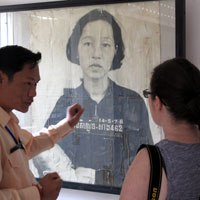
Tuol Sleng victim remembered Up to 20,000 persons may have come through this facility en route to the mass burial “killing fields” outside town during a time when an estimated 2.5 million Cambodians – almost a third of the entire population – died from torture, war, disease or starvation. In 1979, Vietnamese forces ousted the Pol Pot regime and brought to an end the horrors of Democratic Kampuchea and the country’s ill-starred foray into agrarian communism that had practically eliminated intellectuals, teachers, religious leaders, traders, craftsmen, and any semblance of normal, urban life. In May 1993, UN-authored elections ushered in a new era. Shopping, bric-a-brac, and some fun stuffAnother five minutes in a bumpy tuk tuk heading south from Tuol Sleng will bring you to the old Russian Market, a labyrinth of stalls selling everything from knock-off DVDs (Fawlty Towers, the British sitcom three-CD set, for US$4), bracelets, t-shirts, jewellery, lampshades, bowls, and small Bayon head replicas in stone and silver (from US$15). In the heart of this darkly enticing, if claustrophobic, sprawl are crowded food stalls wreathed in smoke and the aroma of Khmer herbs and sauces. Whatever you’re buying, bargain hard. The same holds true in the bigger, art deco, yellow domed Central Market (Phsar Thom Thmei), farther north, not far from Wat Phnom and the Train Station (largely inoperative while a major ADB-funded overhaul of the railway system by 2013 steams along). The Central Market building provides the focus for a hive of activity as pushcarts and bicycles hauling everything from coconuts to clothes and jewellery elbow their way through the busy side streets. Close by is the modern Sorya Shopping Centre, a modest high-rise selling aspirational brands and consumer items. Other Phnom Penh shopping centres include Orussey Market and the more distant Sovanna Shopping Centre in the southwest of the city. 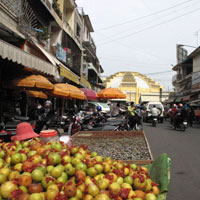
Art deco Central Market West of the Royal Palace along Street 240 is a lively stretch of shops and restaurants. Mekong Quilts (tel: [855-23] 219-607, www.mekong-quilts.org, number 49, Street 240), a non-profit community development organisation, has an outlet offering a good base for exploration. Colourful handmade quilts (from around US$140) and patchwork creations, line the walls. On this block are the Cambodian Craft Cooperation (tel: [855] 12-766-980), Mekong Creations (tel: [855-23] 210-545), wanderlust (tel: [855-23] 221-982, www.wanderlustcambodia.com) for accessories, clothes and jewellery, and Couleurs D’Asie (tel: [855-23] 221-075, www.couleursdasie.net) with a wide range of home furnishings and vibrant fabrics. Take a breather at The Shop (tel: [855-23] 986-964, number 39, Street 240) for chocolate nibbles, or at The Tamarind bar and restaurant (tel: [855] 12-830-130, www.tamarindrestaurant.biz) for tapas and kebabs. On Street 178 are art and antique shops with oil paintings by the yard. Nothing inspirational, but a touch of Cambodia nonetheless. For the more adventurous, Blazing Trails (tel: [855] 12-676-381) runs well-supervised guided excursions through countryside grit and paddy on quad-bikes with hotel pick-ups and drop-offs, while the Kambol Kart Raceway (tel: [855] 12-232-332), a short distance from town west of the airport, has almost a kilometre of snaking track. And for more throbbing metal between the legs, there’s always Harley Tours Cambodia (tel: [855] 12-385-157). Phnom Penh nightlife, Khmer food, bars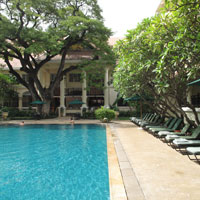
Raffles Hotel Le Royal pool Much of the nightlife bustle is concentrated along the Tonle Sap River. A broad promenade runs along its west bank, bordering Sisowath. You can see the mighty Mekong ahead plodding towards the confluence of the two rivers. During the summer monsoons as the waters rise, the rivers actually reverse their flow and the Tonle Sap Lake (close to Siem Reap) dramatically expands with renewed life as fish and nutrient-rich silt are deposited upriver chased by bobbing fishing boats. Strung along Sisowath are the usual slew of tourist-trap nosheries, pizza cafes, and bars, mostly fun and rarely patronised for fine food unless fortified by several pints. The Lonely Planet-recommended Anjali (tel: [855] 12-457-901) proved an excellent and cheery pit stop until I bit into the chicken tikka. This immediately banished all notions of a sumptuous repast. With my teeth barely intact after industriously attacking the dry chunks of charred meat, I executed an honourable retreat, hiding the tikka remnants under lettuce leaves so as not to offend the smiling waitresses. The K-West Restaurant and Cafe (tel: [855-23] 214-747, number 1, Street 154, Sisowath Quay) at the chic Amanjaya Hotel is a bright and comfortable choice if you’re worn out and starving, with a varied menu including Khmer. And the hotel’s rooftop Le Moon terrace bar is a happening late evening chill-out spot with breezy river views and tall drinks. Close by, and an eternal favourite of journalists, is the FCC Phnom Penh (tel: [855-23] 992-284, www.fcccambodia.com). This is a two-storey colonial walk-up with an unbeatable corner location on Sisowath. Think great river views, a convivial bar, and tall stories always on tap. La Croisette (tel: [855-23] 220-554, number 241 Sisowath Quay) also offers ambience and a corner location with nice views and a predominantly Italian pizza-and-pasta menu that at times makes a supreme effort to be passable. 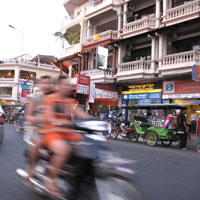
Sisowath Quay evening bustle Still popular on the quay are a clutch of “happy pizza” joints, once famed for their magic mushroom concoctions, now thoroughly sedate, if occasionally open to persuasion by regulars in search of a broader vision peopled by flying cows and radiantly pink skies. Given the limitations of a small town, Phnom Penh dining does offer a fair amount of variety and those in search of Khmer cuisine will find several spots to satisfy their curiosity and, sometimes, palate. On Sisowath is the grand, riverside Bopha Phnom Penh Titanic Restaurant (tel: [855-23] 427-209, www.bopha-phnompenh.com), which, despite its alarming name, offers apsara dances from 7pm each day and an unsinkable mix of Khmer and Western dishes. Down the road is the cosy cubist-cane-chair Khmer Borane (tel: [855] 12-290-092) that attracts alarmingly mixed reviews but remains a well-frequented establishment. Khmer Surin (tel: [855-23] 993-163, number 9, Street 57), housed in a traditional building, serves Khmer and Thai food with dollops of ambience. Park in the verandah or balcony and try the steamed and fragrantly curried fish amok. From Mith Samlanh (“friends” in Khmer), an enterprise to empower and educate street kids, come the training restaurants Romdeng (tel: [855] 92-219-565, number 74, Street 174, www.mithsamlanh.org) and Friends the Restaurant (tel: [855] 12-802-072, number 215, Street 13). At Khmer-cuisine Romdeng, sit in elegant, garden surrounds amidst paintings and silk creations made by the students. While this is a teaching facility, the food is consistently good. 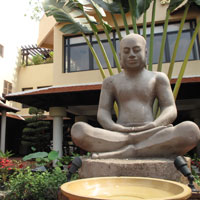
Malis does Khmer food in villa surrounds South of Independence Monument at 136 Norodom Boulevard is the villa-style Malis (tel: [855-23] 221-022, www.malis-restaurant.com). With lotus ponds and stone statues at the centre of a small courtyard, the place conjures up a romantic feel of an evening and serves both traditional as well as contemporary Khmer food. Expect to pay around US$8-$10 for most dishes with friendly but desultory service. For something slightly different and yet more upscale, head to the splendidly colonial VAN’s Restaurant (tel: [855-23] 722-067, number 5, Street 102, www.vans-restaurant.com), set in the 150-year-old former Indochina Bank Building redolent of history. Here you’ll find an eclectic menu with French influences from escargot to Mekong king prawn. A common claim in just about every Phnom Penh guide is that a huge variety of cuisine is available. This is true of the endless lists of restaurants, but an overstatement. With tourists the main target, few places are geared for discriminating taste buds. With new international hotels slowly lumbering onto the scene, the city’s five-star evening menu is stirring, if not heaving, but a must-see is the charming Elephant Bar (tel: [855-23] 981-888, www.fcccambodia.com) at the historic Raffles Hotel le Royal. Expect a high, vaulted ceiling with simple white plaster walls modestly enlivened by elephant frescoes and art deco chandeliers. This is an old world watering hole with glass windows looking onto gardens, a reassuringly well-populated drink list (a glass of wine will set you back from US$6.50), comfy rattan chairs, silk lampshades, carpet underfoot, a pool table, and piano ivories tinkling out ragtime and oldies. For truly grand get-togethers in vintage environs, the hotel has the exquisite Restaurant Le Royal. 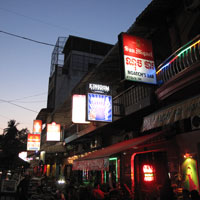
Girlie bars on Street 104 The Sofitel Phnom Penh Phokeethra, farther south along the quay near the convention centre, offers a fresh clutch of river-view dining and cocktail options if street forays are not for you. Phnom Penh bars are not for connoisseurs or the fainthearted. The nightlife spread runs from out-at-elbow beer-and-girl dives on Street 104 (not a very safe area in the wee hours), rising modestly in price and the amount of makeup on Street 136 (and its hostess clubs with unambiguous names like 69 and Pussy Cat), to the discos and lounges along Street 51 (between Streets 154 and 174). This is where you’ll find the much written-up Heart of Darkness, a small, smoky establishment that does not always live up to the hype. It is ripe for people-watching however, a quick shuffle on the dance floor or a shot of pool. Correspondent Stuart Wolfendale describes it thus, “The décor is a stab at something called Khmer-baroque. There is a suggestion of sexual ambivalence in the crowd and the club is listed in gay guides.” Alternatively, the QG (www.qgphnompenh.com) is a new gay bar on Street 172. And the relocated Martini Pub (number 45, Street 95, www.martini-cambodia.com) is an evergreen establishment with live bands on weekends, a giant movie screen and disco. Everywhere, women will instantly materialise and size up your commercial potential faster than your bank manager can say “acceptable credit risk.” The all-in-one Candy Bar Restaurant Guesthouse neatly sums up the typical progression of a naughty night out in the Cambodian capital. Business hotels from classic to modern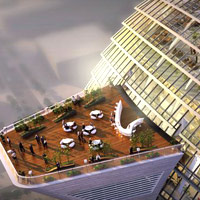
Artist's impression of Rosewood's awesome sky bar/ photo: hotel Pickings are a tad meagre when it comes to high-end lodgings. But this is changing. As flights fill up to the Cambodian capital, international players are stepping in. The Rosewood Phnom Penh (November 2016) with all its attendant luxe trimmings and iconic 'dragon' tower is a 39-storey marvel in an entirely low-rise pancake flat city. The reflective glass 'scales' of the mythical beast rise up and curve inwards, tapering near a cantilevered sky bar on the 37th floor offering grand panoramas made even better by the promise of bespoke cocktails. The hotel occupies the top 15 floors of the easy-to-spot Vattanac Capital Tower One close to - and overlooking - the centrally located Raffles. The 175-room hotel includes 27 residences for long-stay guests who may need something homey and durable as they settle into work or a transfer. Offices run from the third to the twenty-fourth floor while a mega shopping mall will distract with brands like Hugo BOSS, and Rimova, for the luggage starved. The lobby is perched on the 35th floor. Large well-lit rooms look over the central business district, the US and French embassies, and government ministries. Expect pearl pastel decor, a stylish minimalism and black outline furniture akin to Dior dress piping. The end result is smart, stylish and unfussy, accentuating the residential feel of the place. Think large televisions, 50sq m Deluxe rooms with enough room to swing an elephant by the tail, a Rosewood Spa, 20m indoor pool with huge views beyond, gym, four restaurants (including Japanese yakitori), and three function spaces to accommodate 130 to 300 guests in various configurations for small corporate meetings or an intimate conference. The undisputed queen of vintage remains the Raffles Hotel Le Royal Phnom Penh, to the north of the town near Wat Phnom. No less a personage than His Majesty King Sisowath Monivong officiated at the opening ceremony of the original Le Royal on 20 November, 1929. 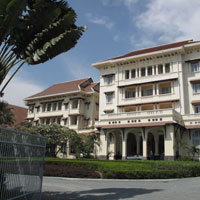
The venerable Raffles Hotel Le Royal The vision of celebrated architect Ernest Hébrard, responsible for much of the stately French colonial stamp still evident in this city, the hotel went on to carve a name for itself and was relaunched with substantial upgrades and a fresh lick of paint under the Raffles name in November 1997. The lobby is small and intimate with a high ceiling and comfy sofas. Austere Buddha statues peer down from various strategic positions to ensure check-in is smooth. Guests can enjoy a nibble here if they feel peckish and, of an evening, a classical trio strikes up, keeping things very much in period. A covered walkway runs from the lobby to the main residential wing, passing the gardens with a large, sun-dappled, swimming pool set on either side. The rippling aquamarine is a sight for sore eyes as the afternoon sun starts making its presence felt. Walk into the residential wing heady with the fragrance of lemongrass. Tiled corridors lead to rooms where the emphasis is on simplicity. Expect pastel-print carpets, plump white beds, and white, glass-paned doors opening onto a small balcony with rattan chairs and a tea table. An old-fashioned wooden almirah faces the bed, housing a defiantly stout box TV, a mini-bar, and a simple electric safe that will accommodate valuables but not a laptop. A wooden work desk offers business travellers the luxury of an internet cable along with complimentary WiFi in-room and in the public areas. The light – and the do not disturb – switches are old-fashioned too, large, labelled, and easy to flip. The bathroom has a decent hairdryer, affixed to the mirror, a bathtub and a separate shower cubicle. 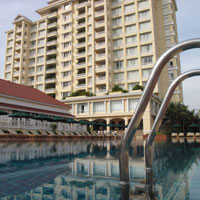
The Sofitel pool catches plenty of sun In all, the place is reassuringly familiar and you will not feel the need to hurry in any particular direction, unless it’s an evening cocktail you crave at the aforementioned Elephant Bar. High tea is another hotel tradition. Service is gracious, always with a smile, attentive to a fault. The Raffles works well as a leisure getaway or a business hotel, as well as a Phnom Penh conference hotel for small corporate meetings and the like. The sheer charm of this establishment coupled with the comparative lack of distraction elsewhere in the city could be a perfect recipe for an unruffled company get-together. Later, head up to the Raffles Spa for a rubdown. A 55-minute aromatherapy session will set you back just US$40 or so. Around the corner is the perennial Phnom Penh Hotel in a faux Khmer style that takes a stab at grand. It has a large swimming pool, stone lions adorn the entrance, and a stately driveway lined with palm trees ushers guests in. There the mirage ends. If you are thumbing through a list of simple Phnom Penh business hotels, this one fits the bill admirably. Expect a health club, spa, shops and boutiques, and a beauty salon. A business centre and a clutch of function rooms are available for pin-stripers in need of a microphone or secretarial help. Rooms have gleaming wooden floors and classic furnishings with the de rigueur silk cushions. Good rates and not a bad location. Along the road from Raffles is the Singapore-managed Sunway Hotel Phnom Penh, modern, brisk, bland, and with 138 rooms. This is a decent mid-range business hotel with contemporary rooms that will not appear too strange, and adequate meeting and banqueting facilities. Internet is charged at US$15 for a day. 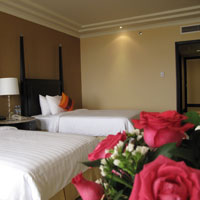
Nagaworld rooms are quite dapper Positioned far south along the quay in an area that is newly developing (with a few residential high-rises emerging), is the 201-room Sofitel Phnom Penh Phokeethra, which arrived December 2010, and is getting all its make-up on. At first glance it seems a tad marooned in the middle of nowhere, with a long driveway (read walk) to the main road where tuk tuk drivers anxiously await. Gardens are coming up and the hotel is on the banks of a slender channel leading from the Mekong River. As worker shanties disappear, this will be a humming district in time, not far from the large convention centre on Diamond Island. The Sofitel’s 1,800sq m grand ballroom can host a reasonable-size bash and there are seven hi-tech meeting rooms for breakout sessions. Mark this down on your Phnom Penh conference hotels list. A major advantage is the fact that it is new. It does not have the history and pentimento surprise of the Raffles but it is a stately edifice with a grand lobby, well presented dining outlets, including Chocolat for dark cravings, and polished, contemporary rooms. A mid-category 47sq m Luxury Room features a sleek flat-screen TV, DVD player, gleaming wood floor and dark-wood furniture, WiFi (for a fee, alas), data-port, notebook-size safe, and lots of three-pin and two-pin electric sockets. Find a generous balcony with open riverfront or city views, smart toilets with twin vanities and generous lashings of black granite, separate shower and soaking tub and, satisfyingly lux fittings and finish. The So Spa is at hand to massage knotted muscles and help you de-stress and the riverside pool catches plenty of sunlight. 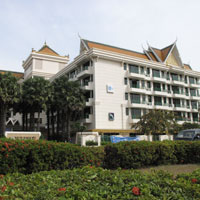
Himawari: long-stay hotel and apartments Moving back up along the river, closer to the Diamond Island Convention & Exhibition Centre, is the bold and brash 500-room Nagaworld Cambodia, a casino that has morphed into a bustling hotel and continues to expand and add rooms. The Nagaworld is in a league apart, if only for its gold statues, fountains, cavernous lobby, marble, busts, spa, and always beckoning casino lights. The roulette tables and slot machines adjoin the lobby so it is pretty easy to slip into the action. Everywhere you turn, it’s bright lights and buzz, not unlike any glitzy Macau hotel on the Cotai casino strip. Rooms are surprisingly pleasant and spacious, not really over the top at all. This may be a hotel on steroids but the bedrooms are calm, in sedate tones, spacious, and with large in-room safes. Bright silk bed runners and orange cushions enliven the colour scheme. Deluxe Rooms have decent, well-lit bathrooms with a shower cubicle only and no tub. Well, who has the time for a languorous soak when there’s money waiting to be thrown away? Internet access is free in the room and there is WiFi in the lobby. Just north of here you’ll spot the Himawari Hotel Apartments, again, modern, and businesslike, with 115 suites, all with parquet flooring, small dining and sitting areas, with free in-room Internet. There is a garden along the river and a decent pool. Also expect a children’s pool, a well-stocked gym, tennis courts, and a business centre. There are several meeting rooms for corporate events. All in, this is an unpretentious, multipurpose address that is a family-friendly hotel option in Phnom Penh. In this zone is the dull, state staple, Hotel Cambodiana Phnom Penh with its pseudo-Khmer overtones, sloppy – if friendly – service and erratic rooms that range from stately river-view suites to musty digs with hideously stained washbasins. It’s all hit and miss. It goes without saying this is an old-style establishment where a sweaty military uniform is entirely in place. 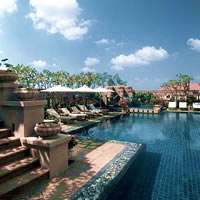
InterCon pool/ photo: hotel To give the place credit, it has downsized (that’s right) from 300 rooms to 250 (plus offices) carving out some useful elbowroom. There is WiFi and it is charged by the hour or day. Not surprisingly the hotel’s website is in disarray with the root name hijacked by some faceless portal. Perhaps it will return. Next door, the Imperial Garden Villa and Hotel is a prime example of the citywide trend towards long-stay hotel-residences. Also stretched out along the river in a prime location, the Imperial serves up 44 villas and 87 rooms with a pool, tennis, health club, sauna, meeting rooms and international restaurants. Remarks correspondent Stuart Wolfendale, “The basic deluxe villas, with two bedrooms, wide-screen TV and individual parking start off at US$3,500 a month, proving that expatriate serviced living in less-developed economies can be surprisingly expensive. The 87-room hotel section over six floors amazingly lacks an elevator.” Close to the Palace and up a creamy gravel drive flanked by gardens, The Renakse, long a favourite of sola topi eccentrics in search of musty mystery, is closed for an overhaul. A 15-minute ride west in the heart of the old town is the 346-room InterContinental Phnom Penh, a mid-rise block set back a short distance from the busy main road with a garden buffer. Rooms are tasteful and bright, with TV, (DVD player in suites), coffee and tea-making facilities and Internet access. Describing itself as the “tallest” building in Phnom Penh, a claim now overtaken by the rush of building activity and the 2016 arrival of the Rosewood tower, the hotel’s earlier preeminence too is under serious threat from the younger riverfront developments. It remains a quietly elegant address, with an enticing swimming pool ringed by stone sculptures, a spa, and reasonable business facilities. The InterCon still has fight so don’t write it off as yet. Boutique hotels and value stays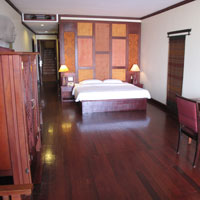
Amanjaya: gleaming touches and space Phnom Penh boutique hotels and budget inns that aspire to the same cachet are seeing a veritable renaissance. Everywhere you turn there’s a boutique this or that. Several guesthouses have upgraded their rooms and facilities to offer a decent low-cost stay, cheap by any Southeast Asian standards. If you don’t expect too much you may be surprised at the value, especially at places closer to the boardwalk action. With an excellent corner downtown location on Sisowath Quay, overlooking both the river and Wat Ounalom is the Amanjaya Pancam Hotel Phnom Penh. This is a friendly establishment with a good restaurant and an after-hours rooftop chill-out bar, Le Moon, open 5pm to midnight. Walk in to be greeted by modern art and graceful stone statues infusing an element of Angkor. There are 21 rooms in three categories, all with some sort of direct or angled river view. The bedrooms are long, just short of a cricket pitch, with gleaming timber flooring, flat-screen Sony TV, sofa set and small work desk. This is 49sq m of stretch space including the breezy balcony. There is an in-room safe to house a small notebook, nothing more ambitious. The dark wood floors continue into the lifts too, a nice touch. The staff are exceedingly welcoming and responsive with a high level of English. This is a stylish small-scale hotel with low-key execution that will appeal to most tastes. Later, at the restaurant, sample zesty Khmer green curry with chicken for just US$6. 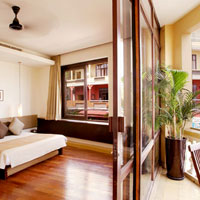
FCC newer room/ photo: hotel Cheek-by-jowl on the same street is the Bougainvillier Boutique Hotel, in similar dark-wood tones with splashes of bright silk. The restaurant is a lot more ornate with intricate woodcarvings and filigree work adorning the walls. Expect attractive, comfortable rooms in a more classical style with a tad more cushions, vases, and grey-stone statues. The neighbourly competition is clearly evident. Not a bad address, also with good views, but a bit more fussy and uptight than the Amanjaya. The FCC Phnom Penh (Foreign Correspondents' Club) staked its claim to the riverfront in the Naughty Nineties and has attracted no small measure of acclaim for its bar and restaurant and unfussy stays. The rooms have slowly expanded in number, taking over adjoining shophouses. The newer ones are modern and spacious with timber flooring and nice balconies overlooking the Tonle Sap River. Bathrooms are delightful with large showerheads. Older rooms, however, are drab and underwhelming. And these sections, combined with a desultory reception that may or may not be staffed, lets the ensemble down a wee bit. The FCC is clearly a focal point for journalists, academics and politicians from just about everywhere and remains a must-see. FCC sister property The Quay, also on the riverfront, is a stylish 16-room haunt with hip design features and an overall minimalist approach. Expect flat-screen TVs, ample stretch space and light woody tones, with contemporary art on the walls and funky modern furniture. This is a Phnom Penh boutique hotel that is headed places. 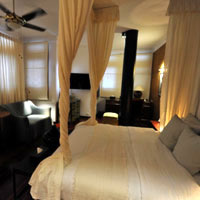
Governors House/ photo: hotel The Governor's House is a gem in a vintage three-storey mansion with 12 rooms breezily done up in teakwood floors, some with gauzy four-poster drapes, others with ancient cabinets and antiques, and whirring ceiling fans recalling an earlier age. Black and white pictures keep you in period at this charming colonial getaway while stylish modern toilets with soaking tubs ensure the day's toil and grime sloughs off so you can enjoy the restaurant, splash in the small outdoor pool or dine poolside, and trawl free WiFi (perhaps from the comfort of a balcony). Sited in an old residential area on Mao Tse Tung Boulevard 3 in Boeug Keng Kong, the hotel is about 10 minutes from the riverside. For something modern and unabashedly contemporary, head to Lebiz Hotel + Library on Street 128. This is in the heart of the city bustle, not far from the Central Market. A late 2010 addition to the city, Lebiz is a cross between a futuristic business hotel and a space pod, featuring laundered white floors and walls and whimsically moulded features. Step out of the city hum into the tiny lobby to find a low glass-sided pool running across the length of the space with the reception to one side and a rack of books and magazines on the other. This space adjoins the Lime Bar. WiFi is free and rooms are mod, startlingly white, with minimal, but thoughtful, touches, including a large flat-screen TV, and a DVD player with audio system resting on a blond-wood table that tapers into the wall, thus opening up space as well as creating interesting visual distraction. 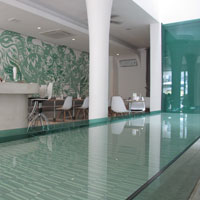
LeBiz hotel: mod, futuristic, smart Expect laptop-size safes, data-ports, lots of plug sockets, and hairdryers. There is a meeting room for 12 persons if you are so inclined, and a spa facility if you are not. Wired and welcoming, Lebiz is a splendid choice among small Phnom Penh business hotels if your needs are not too complex. Midtown on Street 252 is a cosy little hideaway that arrived in 2010, appropriately named the 252. It is easy to miss behind a nondescript, white, sliding gate. Persevere. This is a residential area with a quiet, undisturbed air. Walk in through the mysterious gate to find a charming, small, blue pool flanked by a thatch-roof restaurant/bar on one side and shaded loungers on the other, leading to a low-rise building directly in front. There are 19 rooms in all with free Wi-Fi, some with a balcony overlooking the swimming pool. This is a compact space, well utilised, even chic. Rooms are bright and airy, modern and modular, with a mix of pastel and white walls, 22-inch flat-screen LCD TVs, DVD players, iPod docks, and safety boxes. Massages are dished out poolside. With the room price tag starting at US$45, this little retreat is hard to beat. On Street 222 is The Villa Paradiso, a boutique hotel with a spa and restaurant. This is a modestly larger establishment with huge rooms following theme designs from Chinese to Japanese and Balinese. Expect varied décor and new surprises behind each door – four-poster beds with gauzy mosquito-nets, bright red fabrics, turquoise blue colour schemes, ceramic washbasins, traditional wooden furniture, quirky artefacts and more. 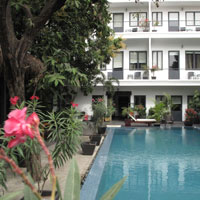
the 252: charming hideaway The rooms offer large LCD-screen TVs (some with DVD players), and a host of movies on demand. The timbered floors are spacious, reminiscent more of a villa home than a hotel. Set in verdant foliage with five spa and massage areas arrayed around it, the green-tile swimming pool is a decent size and catches the rays quite handily. Paradiso’s insistent look-at-me approach borders on loud but will appeal to many. Grand, colonial, and centrally located on Street 19, The Pavilion is a 20-room hideaway with a 14m saline pool and gardens – all this just a short stroll from the Royal Palace. Four rooms have plunge pools and one comes with a Jacuzzi. Look forward to four-poster beds, wooden floors and creaking paraphernalia. The hotel takes a dim view of sex tourism, and rightly, saying so up front on its website and in brochures. Just to be sure, the minimum age here is 16. The Pavilion works with child protection agencies and, given the antiquity of the building – despite the cramped, old bathrooms – it generally attracts a better sort of clientele. With a midtown location on Street 152 not far from the Central Market, popular stalwart Juliana Hotel offers clean rooms and a pleasing ambience with woody tones in-room relieved by silk bed runners, box TVs alive with the crackle of a variety of stations, and a sturdy work desk. The Executive Deluxe is a tad roomier option with flat-screen TV and a rain shower. Expect a nice open-air swimming pool, Jacuzzi, and Thai massages galore – or foot-rubs if you prefer. 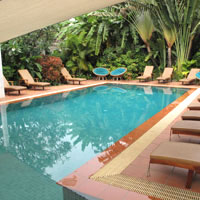
Villa Paradiso has large themed rooms Further down the pecking order are establishments like the new Cardamom Hotel & Apartment that doubles as a long stay residence, offering flat-screen TVs and balconies, and the old-style Holiday International Hotel, with a pool, bar, and small meeting facilities. Then come brazen pretenders, like the self-styled Amari, which has a sign outside proclaiming it to be the Amari Watergate Hotel (after the Bangkok property of the same name). Never a dull moment in Cambodia, “Kingdom of Wonder” as the slogan goes. Send us your Feedback / Letter to the Editor FAST FACTS / Hotel Contact ListConventional wisdom has it that the best time to visit Phnom Penh is between October and April to avoid the monsoon season – although prices are lower then and it does not rain all the time. Temperatures vary through the year with highs of between 22C and 38C. Humidity tends to be high but drops at the peak of winter when nights can cool down considerably. Visas valid for a month are obtainable on entry at airports for US$20, although citizens of many countries don't need visas. Have two passport photographs ready and ignore agents, particularly on the Internet, who try to advise you otherwise and want to charge you for obtaining your visa. (Visa availability may not be that simple when crossing into Cambodia overland from Vietnam or Thailand. In such cases it's best to check in advance.) 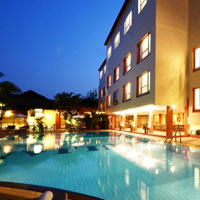
Juliana pool/ photo: hotel There is normally a 10 percent government sales tax on hotel and restaurant bills, though sometimes these are included in the price. The inclusion of service charges on bills varies. More information at Tourism Cambodia (www.facebook.com and www.tourismcambodia.com/). Tipping about 10 percent is appreciated at premises catering for foreigners. Room prices, especially at Phnom Penh boutique hotels, are flexible, particularly during the summer monsoons. Rates quoted here are for rule-of-thumb only and represent Internet quotes or the best available rate (BAR). The exchange rate for Cambodian riels is roughly US$1 = Crl4,080 but it is often rounded off to around 4,000. Phnom Penh business hotels and boutique staysAmanjaya Pancam Hotel Phnom Penh. Tel: [855-23] 219-579, fax: 219-545, (e-mail: reservation@amanjaya-pancam-hotel.com or www.amanjaya-pancam-hotel.com).
NOTE: Telephone and fax numbers, e-mails, website addresses, rates and other details may change or get dated. Please check with your dealer/agent/service-provider or directly with the parties concerned. SmartTravel Asia accepts no responsibility for any inadvertent inaccuracies in this article. Links to websites are provided for the viewer's convenience. SmartTravel Asia accepts no responsibility for content on linked websites or any viruses or malicious programs that may reside therein. Linked website content is neither vetted nor endorsed by SmartTravelAsia. Please read our Terms & Conditions. |