
 Sign up for our free monthly news and lucky draw alerts |
OUTPOSTS Yerevan, a road less travelledDo you know where Armenia is? Well, chain-smoking business travellers are making a beeline for the capital, filling the few Yerevan business hotels.     SEE ALSO Almaty hotels | Tashkent guide | Bishkek guide | Istanbul hotels | Ladakh guide | Uzbekistan guide | Inner Mongolia JUMP TO Sightseeing | Yerevan dining | Getting to historic sights | Business hotels | Budget hotels and hostels | Cable car adventure 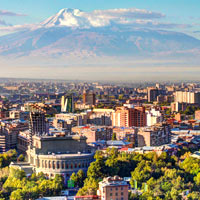
That obligatory mountain backdrop THE magnificent twin peaks of Mt Ararat – where Noah’s magnificent ark came to rest after the Flood – soar above Armenia’s capital Yerevan, the greater mountain a 5,000m-high volcanic dome capped by glacial snows. The mountains border Turkey. I couldn’t see a thing as the plane descended through the clouds and assumed the animals that had arrived two by two were still happy and gainfully employed at some modern zoo. The flight was packed and even I, a veteran of nose-against-the-glass window-seat travel, was unable to gain my usual perch. Another problem is that most incoming flights from Europe arrive at the ungodly hour of 4am or thereabouts, in pitch-black darkness. There are more Armenians outside Armenia than inside, and a lot of them like to visit the old country now that it's beginning to pick its head up. But this flight seemed to be full of tour groups wanting to visit the world's oldest Christian nation, and serious business types looking to make speedy money. Immediately after exiting the aircraft, you go down the escalators past grim-faced ex-Soviet guards, and arrive at a swanky change machine and teller. Exchange your money here, because you’ll need it for your visa-on-entry and taxi, and also won’t get an opportunity to pick up a few tens of thousands of Armenian drams (exchange rate US$1 = AMD485) until after you arrive in the city, and it is daytime. (Of course, finding AMDs anywhere in your home country is a near-impossibility.) I arrived on the same flight as a German tour group that made a beeline for the teller counter. The queue was impressive. Why on earth would you do that when there’s a perfectly good working machine next to it? It sucks in dollars and euros and spits out AMDs. To its left are a series of counters that look like pre-paid taxi booths in third world countries but are, in fact, where you pay for your visa – if you hold a passport from one of the approved countries listed at the Armenian foreign ministry website.
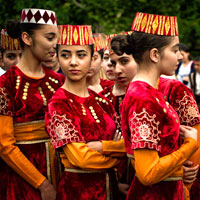
Always ready with a folk dance to celebrate any occasion Most nationalities automatically get a visa on arrival. But if you happen to be born in one of the 18 or so countries – including China (but not Hong Kong), India, Sri Lanka, and Vietnam – listed on the site, which require an “invitation”, you’re sunk. First off, you need an official invite to visit. This process may take several weeks... or forever. After paying for your visa, head to immigration, where beeping red LCD numbers and a pretty girl (in case you can’t read) direct you to a free booth. Another surly Soviet-era immigration agent who barely speaks English will thoroughly examine your passport and other documents before carefully stamping your visa. A quick walk through the duty-free shops (you have no choice, that’s the only way to go, IKEA style) and you reach the bags. Be sure to keep your baggage tags, as customs will not let you pass without examining the luggage to ensure it is indeed yours. This led to an interesting moment. The customs agent saw my passport, and exclaimed, “Indian?” He then proceeded to chat with me using a few words of Hindi. Welcome to Armenia! Outside, a gaggle of taxi drivers await. If you haven’t pre-booked a ride through your hotel, negotiate hard; but you will probably not reach the right price at this time of the night, which is in the AMD1,500-2,500 range for the 15 to 20-minute ride to the city centre. Yerevan can be stifling hot in the summer, with daytime temperatures soaring up to 40 Celsius and a strong sun creating a ripple haze in the air. Winter dips way below freezing, hitting a seasonal average of minus 8C in January. The rest of the tiny country has different microclimates as well, and there is a ski resort near Lake Sevan in the north. Check you visa status online at www.armeniaforeignministry.com. Sights, and the world’s oldest shoeLandlocked Armenia is tucked in between Georgia, Turkey, Iran and Azerbaijan. Yerevan, the capital, is a medium-sized Eurasian city with a population of a little over a million, all of whom appear to be throwing off the industrial shackles of Soviet-era control – and war with Azerbaijan – to head resolutely in the direction of good old-fashioned capitalism. Ladas and Volgas fight for space with custom-paint-job Hummers and Mercs, and all this frenetic construction has created a new class of powerful oligarchs. But at 5am it’s hard to see anything at all, so head to your hotel to wait for sunrise. Mt Ararat is a splendid sight on a clear day. Send us your Feedback / Letter to the Editor 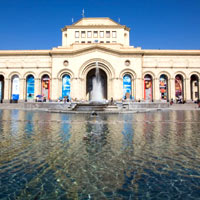
National Gallery - Yerevan has several squares, monuments and fountains When you do head out, pick up a map from the hotel reception. The city forms a small grid inside a circular road that changes name from Sarian Street to Moskovian Street to… The names of the streets are often different on different maps as there’s no exact transliteration of Armenian to English. Thus, Abovian and Abovyan are the same, and that’s an easy one. Two focal points are Republic Square (or “Hanrapetutyan Hraparak”) and Yerevan Opera House. Everything else isn’t much more than a 20-minute walk. Most middle-class Armenians live in ramshackle Soviet-style apartment blocks in cités far outside this grid, so if you really start exploring (ala couchsurfing.com, for example), you’ll discover a completely different world. But as a regular tourist, you’ll have quite a lot to do in the city centre. History amateurs will be fascinated by the State Museum of History on Republic Square where, for the measly price of AMD1,000 - or AMD5,000 for a guided tour - you can check out the world’s oldest shoe – a 5,500-year-old laced leather moccasin with hay “‘socks” that was discovered in a cave two years ago (making it older than poor Otzi the Iceman and his previous record-holding shoes). There’s even a New York Times article about it: www.nytimes.com. The museum also has a large number of prehistoric artefacts belonging to the horse-taming Indo-Europeans, including chariots, a massive bow, gold jewellery and more. This is all interesting (and it is fantastically so) only if you already know the context. All the signs are in Armenian (or Russian) and there’s usually no one to explain any of this, unless you’re lucky enough to find an English-speaking guide that particular day. The museum is closed on Mondays. After the museum, hail a cab or stroll to the world-famous Yerevan Brandy Company (also sometimes the Ararat Cognac Factory). The names of Armenian institutions seem remarkably fluid. Enjoy, a tasting tour. There are at least two different cognac factories here, one called Noy Ararat and the other just Ararat. The two factories face each other across the river, and both give the same tours with the same stories. 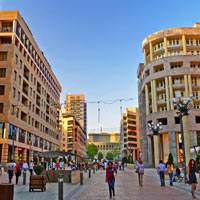
Most places are walking distance around the modern city centre My understanding is that the company split into two, so both places share the same history. The factory was built on the ruins of an ancient fort, because back in the 19th century history didn’t matter all that much. For AMD3,500 you can sip various versions of Churchill’s favourite brandy, from one aged 10 years (boozy strong) to one aged 20 (very smooth). After your three snifters, you should be ready for lunch and a siesta. If drinking fancy cognac or wine is not your thing, you can head to the Matenadaran library, a monumental grey building in a leafy setting at the end of Mashtots boulevard. It contains more than 100,000 ancient manuscripts, some of which are hand-drawn Armenian copies of books that disappeared long ago. A museum open to the public is located in two rooms on the top floor, and displays a few of the brightly coloured medieval manuscripts that monks so carefully created and preserved centuries ago. The entrance fee is AMD1,000 per person with an exorbitant surcharge for cameras. The library is closed on Sundays and Mondays. There is of course Tsitsernakaberd, an Armenian genocide memorial and museum, on a hill a little outside town. The monument and museum were constructed in remembrance of the first great genocide of the 20th century, committed by the Ottoman Empire during the first world war. Entry is free although donations are welcome. For something lighter and a spot of Yerevan shopping, there are two main bazaars. One is inside a historic building, where vendors selling dried fruits and nuts (a local speciality), sausages, homemade wines and vodkas, charm tourists into buying their wares by offering them a taste of everything. This is not the case in the ‘modern’ bazaar where local Armenians actually do their shopping – unidentified cuts of meat mingle with live fish, and yes, dozens of stalls of formal shoes. Armenians like to dress really well. If you’re lucky enough to be there on a weekend, check out the Vernissage market, where you can buy all kinds of junk – from “Armenia!” t-shirts to Soviet medals and used books. Yerevan is possibly one of the cheapest places in the world to enjoy opera in a fairly small and intimate setting. I was lucky enough to be there while the Royal Philharmonic was visiting, and saw them perform – we paid AMD25,000 to be seated four rows from the stage. (Much of the cheering and “bravos” seemed to be for the local heroes, the soprano Hasmik Papian and bass Barseg Tumanyan.) Kebabs and fruit wine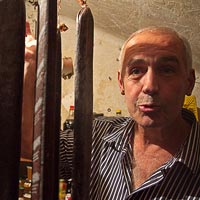
Sausages everywhere you turn/ photo: Apoorva Prasad By now you’re probably starving, so walk just behind the Opera – in a green quadrant between Sayat Nova and Mashtots avenues – to find an open-air cafe. Most ‘cool’ Armenians hang out here eating, drinking, listening to live music and generally making merry. Armenians like to eat barbecues (khoravats), vegetables, chicken and kebabs, and drink many kinds of fruit wines and vodka. The national bread is “lavash”, a thin pita-like flatbread. These days, many Armenians are more excited by international and American cuisine, but I found that Tumanyan Street (among others) is filled with Armenian fast-food joints, most of which are remarkably cheap and good. I found myself stopping twice at the unprepossessing Mer Taghe cafe-bistro (21/1 Tumanyan, just next to Mamma Mia pizzas). They have a delicious award-winning chicken wrap for AMD900, best washed down with the local beer, another AMD900 or so. If you’re looking for fancier ambience, a little higher on the price range is Our Village (5 Sayat Nova), popular with tourists and the expat crowd. The (slightly standoffish) waiters and waitresses are costumed in the national dress, and pretty decent traditional live music entertains evening guests. The food is decent (but not great), but it’s still quite popular, so you should reserve at least a day in advance. Our bill for four people with drinks came to around AMD14,000. Another fancy option just next to the Armenia Marriott is the Ararat restaurant, which looks really ritzy but turned out to be quite affordable – about the same price range as Our Village. Historic sights beyond YerevanOutside Yerevan – ranging from a 20-minute to a two-hour drive – are some great historical sites. Echmiadzin is the holy see of the Armenian Church and a UNESCO site. With a construction date of AD 301, it’s one of the oldest cathedrals in the world. 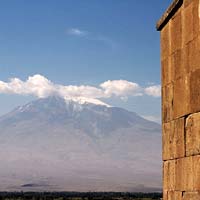
Khor Virap views of Mt Ararat/ photo: Apoorva Prasad Garni gorge has a Roman temple from the 1st century, and the gorge itself is a geological wonder, with straight basalt columns that appear to be artificially constructed. Khor Virap, just below Mt Ararat, is where St Gregory was supposedly kept in a black pit for 12 years (you can visit the dark hole under the cathedral). And Noravanq monastery, a two-hour drive away, is hidden within a craggy canyon where we did some rock climbing – Armenia is a hidden gem for outdoor activities. You probably haven’t been able to do all this in one day, but either way you’re now exhausted and want to head to your hotel to sleep off all that cognac. Business beds and massage therapistsYerevan has seen a construction and hotel boom in recent years – there are apparently some 30 hotels in the city, but only two belong to large international chains. Pretty much every decent hotel in the city is a business venue. There’s very little ordinary tourism here (the only tourists are from the returning Armenian diaspora). Thus, at Yerevan business hotels, there’s very little emphasis on great design, great service, or great anything at all. Even though I was reasonably dressed – white shirt, blue jeans – non-reception hotel staff at various locations gave me and my camera odd looks, ranging from curious to suspicious. The Armenia Marriott Hotel (tel: [374-10] 599-000, fax: 599-001, (www.marriott.com/) is one of a handful of international hotels in town and certainly one of the fanciest. It’s certainly big, a massive structure in the middle of Republic Square, opposite the State Museum and the Ministry of something-or-other. There are 215 rooms spread over nine floors and two wings, two cafes, a bar and two restaurants (Italian and international), a fitness centre, a few suites and several business meeting rooms. 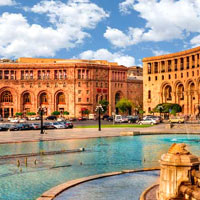
The Armenia Marriott/ photo: hotel My room on the executive floor was adequate, the minibar was packed with goodies and the mess I left everyday magically disappeared (except for my rock climbing gear and rope, which the hotel staff left wisely untouched as the strange trappings of a madman). The king-size bed had a gazillion pillows, perfectly soft and turned down. The executive lounge was well stocked through the day and I happily munched on the local dried fruits in the evenings. There’s free WiFi in the lobby and wired access and WiFi in the rooms for a fee. There’s also the rather nice Meeting Point outdoor café, which is a great first-day acclimatisation and people-watching spot. But... there are a lot of buts. The Marriott, like pretty much every decent hotel in the city, is a business venue with a poorly designed interior. The fittings look circa 1980s. The elevator is tiny and has some sort of steampunk thing going on with its card reader (one elevator refused to read my room card on two of the days I was there). This is all changing now. The breakfast spread here (included) makes up for quality with quantity. There’s also no swimming pool (but a large empty central courtyard filled with junk). All this after the hotel was renovated. Overall, the Armenia Marriott has one of the best locations in the city, but the cracks are more than visible. Guests are allowed to smoke – and they do, crowding the corridors – customer service is desultory, and PR staff are often diverted to other tasks, like selling strudel. Just down the road is the equally well-located newcomer Hyatt Place Yerevan (tel: [374-10] 1122-1234, fax: 1122-1235, yerevan.place.hyatt.com), which serves up bright and comfortable rooms with all the regular mod-cons and free WiFi. Even standard rooms have their own sofa sleeper section so there is plenty of space to stretch out here. Don't miss the free breakfast at the Gallery Kitchen. There's also a 24-hour StayFit Gym to work up a sweat, or you take a dip in the indoor pool. Grab a nightcap at the Coffee to Cocktails Bar to wrap up your night. 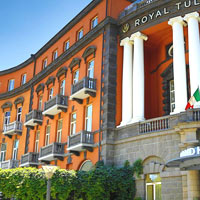
Royal Tulip facade/ photo: hotel An alternative choice is the three-star Best Western Congress Hotel (tel: [374-10] 591-199, fax: 522-224, www.congresshotelyerevan.com). It actually appears to have modernised in recent years, with LCD TVs, complimentary WiFi in all the rooms, and a large restaurant overlooking a pretty nice pool. I may be harping on a bit about a pool, but Yerevan gets up to 40C in the summers, and even in late September I was sweating in a t-shirt. Also, it’s a decent leisure amenity in a city devoted to business travellers, and the hotel even has a massage therapist on hand to work out your aches and pains. The hotel is barely a 10-minute walk down large shady boulevards from Republic Square. While it doesn’t have the impressive cachet of being across the street from the State Museum and having a balcony view of Independence Day festivities and whatnot, it’s not hugely far from things. The rooms are a bit smaller, as is the lobby and entrance, but the staff are friendlier. The receptionists laughed in mock outrage when I questioned their three-star rating. The hotel’s e-mail is about as erratic as the Marriott’s. The last of the top hotels in the area is the Royal Tulip Grand Hotel Yerevan (tel: [374-10] 591-600, fax: 591-666, www.royaltulipgrandhotelyerevan.com), formerly the Golden Tulip Yerevan, a short walk from Republic Square. The hotel completely renovated in late 2009 to freshen up its 104-room inventory. I walked in past the doorman (the only black man I’d see in all Armenia) to a narrow reception lobby. While I waited for the PR lady to come down and show me around, odd-looking grim men milled about the lobby, taking up all the four chairs, and I couldn’t figure out if they were staff or guests or maybe secret police (Royal Tulip is in fact a former Intourist establishment). 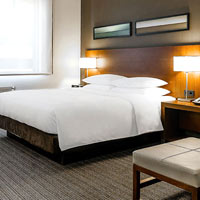
Hyatt Place, free WiFi/ photo: hotel But past the lobby the hotel opened up to an interior garden, open all the way to the roof. The sense of space was definitely welcome. This was also the hotel’s cafe/bar (shut for the afternoon – businessmen are off working, obviously). There’s a small but reasonable business centre, an average gym with men's and women’s changing rooms and free WiFi. After despairing at all these “big” business hotels, I decided to check out Hotel Meg (tel: [374-10] 581-008, fax: 583-172, or www.hotelmeg.com), which bills itself as the only Yerevan boutique hotel. It wasn’t very easy to find initially, since it’s on a small street off the main avenues. After walking for about 30 minutes from my downtown cafe, I found out I’d taken a wrong turn somewhere, and eventually realised that it was reasonably located, just a half-minute stroll from the ancient manuscripts museum, the Matenedaran Library. But there are no signs or boards on the outside. “To prevent drop-ins”, says Aris Ajand, Meg’s US-returned Armenian manager when I was visiting. Apparently Yerevan is also chock-full of love hotels, and Ajand needs to ensure Meg’s not mistaken for one by young amorous couples. Ajand says that the reason for the hotel’s exceptional ratings is that he’s got the best service. There are only seven rooms, including a two-bedroom suite. The rooms are spacious, modern, with clean, minimalist fittings, the usual mod-cons (still no flat-screen TV), a kitchenette and dining table. “We’ll give you the breakfast you want”, he says. For dinner, if “you want Chinese, we’ll go and get you the city’s best and lay it out for you, and we don’t charge anything extra”. Meg feels less like a hotel and more like a large, super-serviced apartment. In fact, the hotel’s secret weapon – and key probably to its high ratings – is Ajand, who gave me more tips on Yerevan in a half-hour of conversation than I’d been able to get in nearly a week of weary exploration. Ajand showed me both the suite and regular double. “I went and got the best mattresses in town, as good as the Marriott’s”, he says. Meg’s only real flaws are that there are no other amenities or even space beyond the rooms, so it’s probably more appropriate for travellers here on regular medium to long-term work; or those looking for a small, homey hotel. 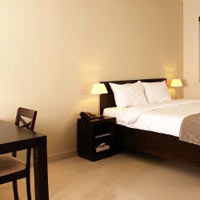
Hotel Meg, boutique touches/ photo: hotel The Tufenkian Historic Yerevan Hotel (tel: [374-60] 501-010, (e-mail: hotels@tufenkian.am or www.tufenkianheritage.com/en/) opened late 2012, is an interesting heritage building located at the crossroads of Buzand and Hanrapetutyan streets. The structure is true to 19th century Armenian architecture but the hotel's 85 rooms are modern and bright. Guests staying in the suites can enjoy complimentary turndown service, movies on demand and even drop off tots at the children’s welcome programme. Book your stay on the hotel's website and they'll toss in free airport pickups too. Another newcomer is the Republica Hotel (Republica Hotel (tel: [374-11] 990-000, http://republicahotel.am) situated close to the Republic Square down the road from the Armenia Marriott. The rooms boast Armenian artworks, and are clean and well maintained. Staff is friendly and efficient, and the breakfast spread is not to be missed. Budget hotels and hostelsLower on the price scale (and quality) is Erebuni Hotel (tel: [374-10] 580-505, fax: 580-330, e-mail: info@erebunihotel.com or erebunihotel.am) where friends of mine stayed. It’s priced like an ordinary two or three-star hotel in Western Europe, but looks a bit more like a clean Asian brothel (or honeymoon hotel). Fuschia rooms and bright bedcovers provide the right ambience. Yerevan budget hotels include hostels and homestays. Envoy Hostel (tel: [374-10] 530-369, (www.envoyhostel.com/yerevan) is neat, clean and basic. It also runs the popular Envoy Tours, flyers for which you’ll see in a lot of the city’s hotels. The hostel is located in the middle of town, not too far from the Opera or Republic Square. There are dormitories and private rooms, common showers and bathrooms for men and women, a central common space, a shared kitchen and free WiFi. (And Bible classes, if you’re interested.) 
Resting at Garni gorge/ photo: Apoorva Prasad The staff speaks English and is friendly. The guests when I dropped in were real tourists of all ages and nationalities (ranging from an Australian-Armenian grandmother and a young Scottish tourist to a gaggle of American girls). If you really want some privacy, single rooms start at US$40 a night. But the property is somewhat small, meaning that the (well-lit) common space and many rooms are underground without windows. There are rooms on the ground floor as well, so you could try asking for those. Did you get the cable?Although tourists are few and far between in Yerevan, there is a new attraction which could start pulling in the crowds. Spanning 5.7km over the spectacular Vorotan River Gorge to the 9th century Tatev Monastery, it is the world’s longest cable car line (it claimed the title from The Sandia Peak cable car in New Mexico, which is a piffling 4.3km). Funded mainly by private donations, the US$18m-project provides year-round access to the monastery – one of the country’s most significant religious centres. Local people can ride the Wings of Tatev for free while visitors pay AMD4,000 (US$8.50) for a roundtrip ticket. The line runs between the village of Halidzor and the village of Tate, a short walk from the monastery. The dangling cars travel at 37km per hour, take 11 minutes one-way and offer stunning views from heights of up to 320m. (Although judging by Yerevan’s hotel lobbies – the cabins are likely to be flying ashtrays packed with chain-smoking businessmen – not quite so scenic.) Along with the world’s oldest shoe, this record-breaking cable car line is likely to make Yerevan a more familiar name on tourist lips. But if they do come, let’s just hope there’ll be room at the inn.
NOTE: Telephone and fax numbers, e-mails, website addresses, rates and other details may change or get dated. Please check with your dealer/agent/service-provider or directly with the parties concerned. SmartTravel Asia accepts no responsibility for any inadvertent inaccuracies in this article. Links to websites are provided for the viewer's convenience. SmartTravel Asia accepts no responsibility for content on linked websites or any viruses or malicious programs that may reside therein. Linked website content is neither vetted nor endorsed by SmartTravelAsia. Please read our Terms & Conditions. |