

Sign up for our free monthly news and story alerts |
INTERVIEW Being a good host comes first: this builds revenue, reputation
Torsten Richter, GM at the renovating Anantara Siam Bangkok, is to the point. Hotels can be exhausting. So you need passion and joy in this field. Simply put, "Love it or leave it." For guests, luxury has become more informal, he says. "And we try to fulfil 'unspoken' wishes."    May 2026 SEE ALSO Franz Donhauser | Novi Samodro | Choo Leng Goh | Maria Helena de Senna Fernandes | Anchalika Kijkanakorn | Cavaliere Giovanni Viterale | Hans Jenni | Iwan Dietschi | Peter Caprez | Louis Sailer | Richard Greaves | Ruby Garcia | Carina Chorengel | Michel Chertouh | Wartime Hosts 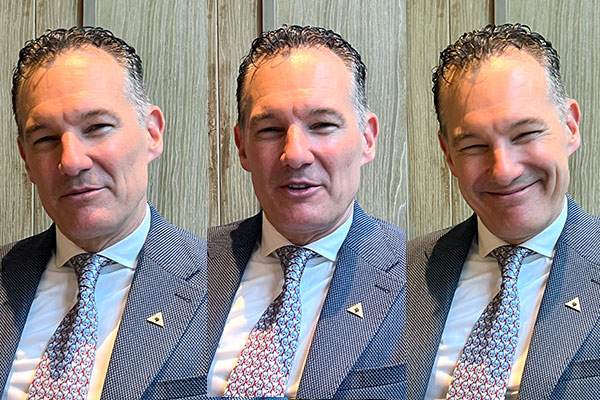
Torsten Richter, ever the immaculate gentleman, coasts in after a 29km bike ride around Bangkok to continue our conversation, fresh as a daisy with not a hair out of place, at Mocha & Muffins/ photos: Vijay Verghese With a US$50 million top-to-toe renovation in progress at the Anantara Siam Bangkok Hotel, plaster is flying. But it is seemingly business as usual on a stormy May afternoon when I stroll into the calming leafy oasis of Parichart Court where koi fish swim through ponds lined with boulders from the River Kwai. This city icon was launched as The Peninsula Bangkok in 1978 — the lobby resemblance is striking — before becoming a Regent, a Four Seasons and then an Anantara flagship. “This is the most significant transformation since The Peninsula days,” says GM Torsten Richter. “ The lobby has never been closed.” He sits at the edge of his seat, coiled like a spring, a tall lithe frame clad in a slim deep royal blue suit, eyes keenly following guests, staff and service at Mocha & Muffins. Born in Germany, Torsten has done the rounds of New York (The Mark), Khao Lak (Le Meridien), Maldives (Milaidhoo), with GM stints in Bangkok (SO/), Tel Aviv (The Jaffa – A Luxury Collection Hotel), Berlin (The Ritz-Carlton), and Malaysia-Indonesia as Area GM for Minor Hotels based at the Anantara Desaru. His energy is palpable and the occasional shy boyish smile is borderline Richard Gere. His words are measured and to the point. There is a Germanic economy of prose. We run out of time and continue our chat 8am the next morning. Torsten has just concluded an early morning cycle loop of 29km from the hotel to Chinatown with a young group he refers to as “fast and furious”. He looks fresh and far from winded in a close fitting grey suit with blazing white shirt and lightly patterned silk tie. His mind is on the upcoming restoration of the lobby ceiling murals, a Sistine Chapel endeavour. The lobby reopened 20 May 2026, the new carpets and furniture following in June. An informal chat with Smart Travel Asia Editor Vijay Verghese 7 and 8 May 2026. Smart Travel Asia: Is there a sweet spot between the competing needs of guests, owners and the management company? TORSTEN RICHTER: A profession should reflect passion and joy [grins]. In the hotel business we talk a lot about this. You have to love it or leave it. This is because of long working hours and dealing with people from corporate to owners to guests — it can be exhausting, and joyful too. To be honest, I believe in balance in life. And this starts with me… to deal with external influences. I do it through sporting activities. Endurance sports show me my limits. My second passion is nature. Did you always want to be a hotelier? TR: My hotel dream was inspired by Richard Schmitz, the GM of Bremen Park Hotel & Spa, the father of my best friend in Baden-Baden. As a young man I’d often have lunch at his GM’s apartment and got to know him. He travelled the world. I could not imagine myself as an accountant [arches eyebrows]. I can’t sit still. And I thought, this seems right. In 1989 I started an apprenticeship in a competitor hotel, the Schlosshotel Bühlerhöhe, now closed. I worked in all aspects of F&B for three years. In fact when I was 14 years old I was already working in the school wine cellar. I liked baking but it didn’t attract me on its own as much as the overall experience. I eventually sat for my exams. (Diploma in hand Torsten worked his way through highly regarded The Mark Hotel New York — as Maitre d'Hotel and Restaurant Manager — before enrolling in Starwood's Leaders Development GM Fast Track program). A fast start then. TR: I was fortunate to get a senior role at the 245-room Le Méridien Khao Lak Beach & Spa Resort in 2008. As a young GM I put in almost four years there and then got an opportunity for a Bali twin opening, which included The Saraswati, a Luxury Collection Resort, and Westin Ubud, before moving on to The Ritz-Carlton Berlin, The Jaffa Tel Aviv and So/Bangkok. Quite a carousel. Unfortunately The Saraswati in Seminyak never materialised. How did this experience shape you? You must have been disappointed. TR: Well my move there was faster than planned. With four months to opening date I could see that much of the land was still bare. I knew this would be an impossible task even if we were to throw in a thousand workers daily. As late as 18 months on we still had bare concrete in most places. The project fell apart with Starwood and the owners not seeing eye to eye. I had put together a great team and had to place them all in suitable posts elsewhere. It was tough [grimaces]. What was your takeaway from this? TR: I would make sure about the completion speed in a place like Indonesia. Would you do another opening? TR: No [emphatic]. I have done [openings in] Maldives, Phuket, refurbishments and new villas in Khao Lak… and I did the opening for The Jaffa in Tel Aviv. What does luxury mean to you? TR: [Thoughtful] I would define it as space, privacy, quality craftsmanship, and service that fulfils unspoken wishes. My lifelong mission is to train staff to understand the idea of ‘unspoken’ wishes. Say a guest walks in sneezing, I would have staff quietly place a tissue box on the table nearby [gestures with one hand]. Staff might offer the guest camomile tea and proffer a handwritten note wishing speedy recovery — unasked. This sort of service is unscripted and respectful. These days we see luxury has become more informal. Why the trend towards informality? TR: People are looking for more outstanding experiences. Every hotel can do a standard city tour. Guests spending two nights in our Jim Thompson Suite can embark on a unique experience [earnest] with a ride in a vintage car to the Jim Thomson residence for a private tour with a personal guide at 5pm when fewer people are around. Then at our Spice Market restaurant guests can enjoy a special menu. Or they might head out for a tour on an electric tuk-tuk. These are the some of the exclusive experiences we craft. What do luxury guests really want? TR: They expect personalisation and fresh experiences. This has been the trend for years. The smarter the hotel the bigger the expectation. In a large hotel this is a challenge. But, at the check-in point, there is an opportunity to get to know guests. Would you profile guests as in the old classic hotels to make note of their preferences? TR: Not exactly ‘profiling’, but yes, we record what people enjoy and we try to serve individual needs. What changed post-Covid? TR: Pre-Covid travel was at a peak in many countries. During the Covid period and on, things that were cool — wining and dining — all stopped. These became uncool. Annual flu never goes away but it is reported less these days. It is always there. In 2022 in Berlin I couldn’t cope with the volume [of traffic]. Travel demand came back faster than expected. At The Ritz-Carlton, Berlin, where I was at the time, had I had the manpower [brow furrows] we could have done much more. I couldn’t find qualified chefs, just part-timers... and they were expensive. It took time to bring back seven-days-a-week F&B operations. And your guests? Was there a demand for contactless operation? TR: Hotel guests moved towards the wellness and spa space. Starwood were pioneers in contactless check-in well before Covid. Contactless mobile phone ordering and check-in became more the order of the day at medium-size hotels. [Thinks a moment and flashes a broad smile] I think 1989 to 1992 was the last time I worked with a hotel that had brass keys [we chuckle]. What is a role of technology at hotels? TR: This is something that needs balance. Systems need to communicate with each other. What of in-room tech? TR: It depends on the generation of each guest — whether they prefer a QR code or a hard copy in their hand. But technology must be accessible and usable. Some luxury hotels use pre-set lighting modes that can irritate guests. TR: Well, rooms need a proper master switch. A few pre-set light settings are fine I think. The guest must have control. An anecdotal measure of a guest’s verdict on quality could be the items stolen from rooms. What are your experiences here? TR: [Laughs] The most popular items are things like hotel slippers, bathrobes and towels. We are not searching every suitcase of course but if housekeeping notes something we would delicately approach the guest [shrugs shoulders, smiles, and gestures broadly with his hands]. Coming back to a pet peeve: is the old lobby-cruising GM dead? TR: In one word: NO! An average hotel may have no need for a GM to shake hands in the lobby. There the GM might concentrate wholly on the commercial side of the business. But in a luxury hotel [gaze settles intently on me] the GM sets the tone through his actions, which are copied. Personal relations is important to secure business. I’ve worked in both luxury resorts and luxury city hotels. At a resort the GM is far more on the floor as guests are wandering in and out 24/7. There is more time at a resort, as in say the Maldives. Here the GM becomes the host. This is why I joined this business. To contribute positively to help guests escape their daily stress. How might a hotel attract quality staff with so much outsourcing these days? TR: In Europe a lot of housekeeping is outsourced. In Asia some hotels outsource security. But in this region the service charge is a main factor in keeping staff as often 10% of total revenue is split between team members. How do you protect brand in an age of click-and-book sales where the hotel’s unique story is often lost? TR: You can use technology to push brand but hotels need to define their brand positioning. And then this [positioning] needs to be followed. Many brands may feel the pressure to fill rooms regardless. But luxury brands will not reduce offerings on services. What is your vision for this brand? TR: I’d like the Anantara Siam Bangkok Hotel to be recognised as the top luxury hotel in Bangkok. You mean in terms of price point? TR: Yes, pricing is important but also product positioning. With this there is great potential to reach new revenue heights. When you look back on your career will you take greater satisfaction in having achieved high profits or would you look at the margin of guest love and loyalty? TR: I’ve worked with many owners who let me focus on quality even if it lost a bit [of profit] along the way. In the long run a focus on quality has resulted in a great experience [for guests and for me] and brought in revenue results for the hotel. I entered this profession to be a host who would give guests a great experience [face creases into a big smile]. This always comes first. Good service is more important than the size of the tip. If a GM can translate all this into more profit for the owners that is also very satisfying. After all we are not a charity. We operate a business. After we make our guests happy we can strike a healthy balance. How are you faring as a ‘wartime’ GM? What are your plans to manage all the changes in traffic and composition? TR: [Frowns] Well, a wartime GM would be in Dubai… right in that zone. But it’s a crisis. And in any crisis there are opportunities. The long-haul and Middle East market has been reduced but we look at the Southeast Asia market — and to domestic consumers for whom we have restaurants that compete very well in Bangkok. It helps our F&B. There are still a few groups coming in. Luxury hotels will hold rates and run on occupancies of 50%-60% perhaps. One must believe in the brand and maintain team motivation as well as guest engagement. Covid was much more severe. It was global. The war is in one region though we feel the effects. What’s your staff to room ratio? TR: We’re running at around 1.35 to one room. That’s high, almost at resort levels TR: Yes it is high. In some areas it can be more efficient. Are many of these veteran staffers? TR: Among our oldest staff a few go back to 1989. These include bellmen, doormen, accountants… and our butcher. We have a large ice-carving team too for our weekend brunch setups and events. Some of them have been with us for many years. How does it feel to be back in Bangkok? TR: It’s great to be back. This is my second time here and there are some good connections. But you need to make sure the city doesn’t consume you [raises eyebrows and smiles wryly]… There are too many events. Hotels have always been viewed as a ‘man’s world’. Is that changing? TR: It’s always good to have a balance. In Thailand frontline staff are largely women. In the kitchen though there may be say 60% men. In this company [Anantara Hotels & Resorts] we have a few Thai lady GMs. This helps motivate more women in the ranks. In Europe I can see it is still mainly a male industry but in Southeast Asia there are a lot of women in this field. At the end of the day, women are dedicated, loyal, responsible. It’s their mother instinct. Are you a fan of ‘agentic’ AI travel bookings? TR: From a hotel perspective I would like all direct digital bookings. With luxury hotels this is not always possible. We get about 30% direct. Personally I have no problem with agentic booking but for a more adventurous trip to Africa or Antarctica I would want a human agent. Humans are better at explaining specific experiences. And I do my research. When I travel with my wife, we research together on weekends but she definitely does more [chuckles sheepishly]. How is it managing guests during a major renovation like this? TR: We are empathetic and generous. Every confirmation letter sent out explains our lobby and rooms are undergoing transformation. Hoteliering was once shaped by the Swiss who followed strict routines and discipline. Have Asian’s had an impact on hoteliering style? TR: I still strongly believe in the old apprenticeship model as it offers a great learning experience. I see a lot more localisation nowadays in China, Thailand and other parts of Asia. Talent is developing fast. But there will always be demand for international hoteliers as they bring a broad perspective. Young generations often think they can go straight into management but experience is not taught in books. It comes with time. Experience takes time. What do you think you bring to the job with your F&B background? TR: A strong operational understanding. F&B has always been a passion point. Anantara Siam Bangkok has long been seen as a great place for F&B. TR: Yes, it’s always been recognised for its food outlets. This is a team effort. Our Aqua Bar is in the Top 20 bars of Thailand. But we are not chasing Michelin stars. We want the dining experience to be approachable with down-to-earth techniques and service. Interestingly, when I talk to affluent customers they might ask me where to get a good simple pizza. I’ll take them to some small back alley café. These people may be billionaires but they really just want tasty comfort food without complication and fuss. Luxury is enjoying these simple, informal experiences.
NOTE: Telephone and fax numbers, e-mails, website addresses, rates and other details may change or get dated. Please check with your dealer/agent/service-provider or directly with the parties concerned. SmartTravel Asia accepts no responsibility for any inadvertent inaccuracies in this article. Links to websites are provided for the viewer's convenience. SmartTravel Asia accepts no responsibility for content on linked websites or any viruses or malicious programs that may reside therein. Linked website content is neither vetted nor endorsed by SmartTravelAsia. Please read our Terms & Conditions. |