

Sign up for our free monthly news and story alerts |
INTERVIEW We are facilitators, an interface, to give guests quality time
Michel Chertouh, MD of the 'new' Regent Hong Kong is staking fresh claim to a storied harbour with his luxury flagship. Passionate, animated, involved, beneath an unflappable laid back exterior, he is French-Brazilian to the core. "TIME, is the new luxury," he says. "It's about how we make people FEEL."    July 2026 SEE ALSO Franz Donhauser | Novi Samodro | Choo Leng Goh | Maria Helena de Senna Fernandes | Anchalika Kijkanakorn | Cavaliere Giovanni Viterale | Hans Jenni | Iwan Dietschi | Peter Caprez | Louis Sailer | Richard Greaves | Ruby Garcia | Carina Chorengel | Wartime Hosts 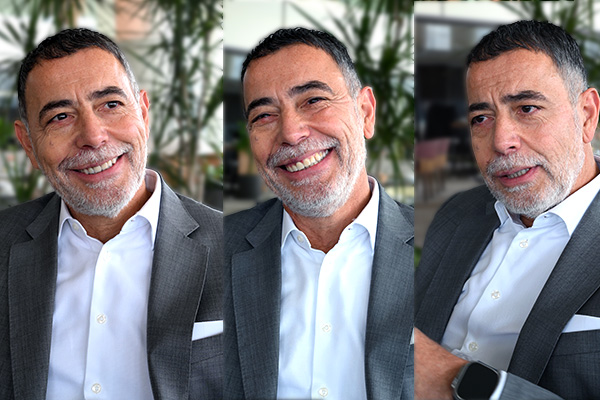
Michel Chertouh, Managing Director of the Regent Hong Kong outlines his vision for this flagship revival and his take on hoteliering in changing times as crisis management assumes greater importance/ photos: Vijay Verghese Michel Chertouh was born in France, the son of a French father of Algerian descent and a Spanish mother. Athletic and light on his feet he glides into the Regent Hong Kong lobby where a reluctant sun is finally breaking through the rain clouds to reveal the storied Fragrant Harbour. Dressed in a slim grey suit with an open neck blazing white shirt, he orders a Coke Zero, strokes his immaculate close trimmed beard, leans back in his chair, stretches out both hands, raps his fingers on the table and looks intently at me. He is cerebral, focused, yet quick to smile and animated, with windmilling hands that help complete sentences and underline points. He has a passion for the job despite his cool laid back demeanour and studied nonchalance. Chertouh moved to Rio on work where he met his wife and fell in love with Brazil, for all intents his home now. He has spent over 40 years with the InterContinental (IHG) group — with stints in Paris, Rio, the Caribbean, Tokyo and Indonesia — as a problem solver GM, luxury hospitality leader, crisis manager, and innovator. He is currently Managing Director at Regent Hong Kong and surrendered a summer morning in July 2026 for a candid chat with Smart Travel Asia Editor Vijay Verghese. Much water has flowed through the harbour since he strolled in to steer the November 2023 relaunch of this Regent flagship — the original article — that is forcing the spotlight anew on this resurgent Asian luxury brand. Smart Travel Asia: When did you start getting interested in hotels? MICHEL CHERTOUH: Well my mother was a pharmacist and my father was a chef in Paris, at a private club near the Élysée Palace. It was quite fancy. I went there often and was impressed. We visited beautiful hotels nearby and historic landmarks. I was five years old and it sparked an interest in the world from the perspective of this [hotel] industry. And your first hotel? MC: The InterContinental Paris in 1986. This later became a Westin and is currently closed to transform into a Jumeirah. It was a great exposure for me. What was your takeaway? MC: It was the luxury around our industry. The celebrities. The King of Saudi Arabia was a regular guest. This was all very different from my world. I started as a trainee in all-day-dining and my first regular position was as supervisor of stewarding. This was after my military service. Interestingly, after my [military] service I also helped with F&B on presidential and ministerial flights taking care of special requirements for the flight catering. In Moscow I had to coordinate things with Air France. It was another world. All this luxury and travel opened my horizons. Everyone loves that word. But what does luxury mean for you? MC: [Brows crease] In today’s world, luxury is TIME. Everyone talks about AI but this is really a way to gain time. We [hoteliers] are responsible to create an environment with aesthetic to give guests quality time. We are facilitators, an interface, connectors… The guest experience should not be imposed. The experience should facilitate what the guest needs. Otherwise it’s an imposition. We make everything easy for you to connect with the destination. There is no hard sell [emphasis]. Did guest needs change post Covid? MC: The new generation has a fresh perspective. My generation enjoys a nice bottle of wine. The new interest is in longevity [smiles]. People realised how fragile we are. There was always a wellness element to travel but Covid was a trigger to accelerate this trend. Has the old structured, disciplined Swiss hoteliering changed to an Asian style? MC: That Swiss hoteliering style was my background [grins]. It’s a legacy, the Swiss tradition of hospitality. But each country has introduced its own style and perspective. There are fewer expats, new skills, but the structure and rigour remains. I always come back to this question like a stuck record but is the lobby cruising general manager dead? MC: The function has evolved. The business requires more than lobby cruising and a fresh balance is needed. Hotels are a business [looks intently at me]. We have to combine lobby cruising and the hoteliering spirit with business needs. Of course, walking the floor is very important. In a big organisation there are reporting lines and as part of day to day operations the GM has to balance this without losing contact with the heart of it all — the guest. [Swivels to face the upper lobby window and waves at a regular guest from Shanghai to whom he has just messaged a personal welcome. Turns to me smiling] We are constantly in touch with guests. It doesn’t always have to be a formal welcome at the door on arrival. We represent the space and the team and the brand. We cannot be invisible. You appear to have a very relaxed style. MC: We are not here to IMPOSE [this is a word that features frequently in our conversation] anything on guests. They should be comfortable. We have to be ourselves. Getting stressed is not part of my nature. I think people might see me as calm, or... unhurried. But I am precise and direct. And I don’t take myself too seriously [grins]. I need to be a problem solver for my team and guests. Having been a 40-year career man at IHG do you sometimes feel you have tunnel vision? How do you reinvent yourself? MC: In our industry you have to be curious. [Leans forward] I am curious. My mind is always on the move. That’s what’s so interesting. We have so many opportunities to discover the world. My training is all classic. It involves grooming, checking the table setup, walking around, as I was trained. But you grow with your environment and your exposure. Can luxury be served with humility? So many high-end products end up being viewed as snooty or cold. MC: We embrace every guest. We try to be as humble as possible. Luxury is how we make people feel. Do you think brands are slowly disappearing with the focus on sales, price, ROI and clicks and so on? MC: It’s always a challenge. We are driven by tools for pricing strategy and revenue management. That’s part of it. But brand is much more than that. We see boutique brands coming in and competing with big brands. So it comes down on how we make people FEEL [returns to this leitmotif with emphasis]. AI can help us a lot in our pricing etc but that’s different. We have to focus on the point when people step into the hotel. How would you measure emotion? MC: It is something we have to monitor and look out for constantly. That’s why we need to be on the floor. We need to spot guest behaviour. Cruising the lobby is the only way to manage this. We have to engage and find out. I even walk the room corridors. The housekeeping trolley is part of the brand image. It says something. Are the towels hanging off it? Are items stored neatly? If I pass a trolley that’s not properly set up I will intervene. It is essential. How do you find empathetic staff in a city like Hong Kong that is transactional and efficient but seemingly guarded emotionally? MC: Hong Kong can be not just efficient but warm. After all we are people. It is possible to be friendly and welcoming and to learn. How do you retain quality staff in these shifting times when attracting the right manpower is such a problem for hotels? MC: Covid challenged our industry and made us think. We have to make hotels more engaging for young people. In my early years as a trainee serving breakfast at InterContinental, the people making coffee were hidden in the back of house. Now these people are positioned front of house as baristas. The role has evolved and become more appealing for Gen Z. Coffee has become an Instagrammable art. But what of the working hours that scare off the younger generation? MC: We cannot run hotels with such long shifts. We need to adapt and balance working hours. What of younger PR professionals and influencers who often focus more on themselves on social media rather than the brands they are supposed to serve? MC: We are always thinking about how to convey what is best for the brand and also work on influencing the influencer [smiles]. We have to take charge. For example here [gesturing towards the scenic lobby windows] we showcase the best Hong Kong harbour view experience of all. This is what you connect with. It’s an immersive experience the moment a guest steps in through our doors. We ensure influencers focus on this, our proximity to the harbour, the energy, the pulse of the city. Have you ever been blackmailed or pressured by someone threatening a poor review? MC: Yes I have been pressured [frowns and shrugs]. If I find an uncomplimentary review I respond in an honest manner. Sometimes we learn from honest criticism. But of course we cannot accept blackmail. Hong Kong has not faced significant travel disruption from the West Asia crisis but what are your thoughts on hosting in a time of war? What does it change? MC: Well, safety is always an issue. In Paris when we experienced waves of terrorist attacks we had to ensure our teams and guests were safe. So we adapted. When I first visited Jakarta I was surprised to see luggage being sent through X-ray machines at hotel entrances. Safety is important. Have you lost traffic due to the West Asia war? MC: Actually no. Many Mainlanders headed to the Middle East have diverted to alternatives like Singapore, Bangkok, Hong Kong or Istanbul. People will continue to travel and explore new options. Dubai always hosts a lot of events and now Hong Kong may capture some of that business. What are your views on hi-tech in hotels? Is it a facilitator or a nuisance? MC: I do not like too much technology in the room. It cannot be a learning process for guests every time they check in… otherwise they’ll move. We need a bit [of hi-tech] but we should not IMPOSE technology on guests and waste their time. Have you experienced any problems with hi-tech yourself? MC: Yes. What about a master switch that isn’t! Or a night light that cannot be turned off. I can relate to these kinds of problems. We all have our own way of using technology. The hotel is an interface to ensure that guests can connect in their own way. What are the other design problems that you encounter? People often wonder if designers ever spend any time at the hotels they dream up, given the constant dysfunctionalities that come to light with usage. MC: I wear glasses. If I take them off I can’t find things [looksup with raised eyebrows as if beseeching the return of simple functionality]. There must be enough hangers. [Coming back to hotel services] I have used butlers but personally this is not something I require. It is good for guests to have their own space. Our luxury guests are always trying to simplify life. They will visit a store trying NOT to draw attention to themselves. They do not wish to be observed all the time. We [hoteliers] need to keep some distance but remain available. VIPs don’t want to be surrounded by people every time they head to the mall. What is the role of women in hotels and is this male bastion changing? MC: [A smile creases the face as he recalls a memory] You know I’m still in touch with the first lady general manager at InterContinental. It was a big event. Dagmar Woodward, a German, greatly influenced female hospitality talent. I don’t consciously hire women. We hire talent and we have a lot of women. You have said that ‘crisis management’ is something you are conversant with? MC: I had a hostage situation once in Rio de Janeiro [in August 2010 gunmen fleeing a police drug bust entered the nearby InterCon and held 35 guests hostage. All were freed without harm]. This was just before the Rio marathon. I had to help evacuate guests, communicate with the city authorities and a SWAT team, who I accompanied to enter and clear all 431 rooms. [Chertouh is an honorary citizen of Rio de Janeiro, a reminder of his formative years there.] A huge crash course in crisis management then. What did you learn from all this? MC: I learned to keep my cool, use common sense, and focus on the task and the liaison work. There were lives at stake. I reviewed the event and learned from it too watching the CCTV footage later that showed me escaping down the stairs [his look indicates that perhaps this was not the smartest move with a gun pointed at him]. I was in Sao Paolo in September 2001 when 9/11 happened with the Twin Towers, and business immediately dropped. Suddenly, people were not travelling anymore. I was in Tokyo, the host of the Olympics, when Covid hit. We managed to survive. Tokyo and Seoul were the two cargo hubs for American supplies and crews [who were allowed to disembark]. It became a lifeline for us. We also had people staying with us who were involved with the Olympics. Then I came to Hong Kong to open the Regent during the pandemic [arches his eyebrows and grins]. What is your vision for the ‘new’ Regent Hong Kong? MC: Simply making Regent Hong Kong the most personal address on the harbour — not the loudest, not the largest, but the most intuitive. This is where the Regent name was born in 1980. The reimagining led by Chi Wing Lo [this was the celebrated Milan-based Hongkong-born architect's first hotel project] gave us the rare chance to write its next chapter rather than merely restore the old version. I want guests to FEEL the building has been arranged around their needs before they’ve even asked for anything. And that is where quiet luxury actually resides, in the anticipation, not loud announcement. The harbour supplies the spectacle. Our role is to provide the the intimacy right in front of it. Is this then different from where the hotel was positioned at launch? MC: The soul is the same; its expression has evolved. When the Regent opened in 1980 it was, in the best sense, a statement. That wall of glass looking onto Victoria Harbour told the city a new kind of grand hotel had arrived, and it was thrilling. That wonder is still in the building’s DNA. What’s different [thoughtful] is that we now express it more quietly. The 1980 hotel dazzled you on arrival; the Regent of today wants to know you by the second morning. Modern luxury to me is less about the grand gesture than the precision of the small ones. Same harbour, same sense of arrival but with a more personal, more anticipatory sense of hospitality. Are there any staff from that initial opening period? MC: Institutional memory is one of the quiet luxuries of a house like this. The finest example is Henry Wong [he pronounces it 'Henri' in the French manner], the restaurant manager of Lai Ching Heen, our Cantonese Restaurant. Henry began his career at the original Regent, stayed through the InterContinental years, and is now back with us under the Regent name once more — a full circle that mirrors the hotel's own history. He carries something no redesign can install, the memory [emphasis] of how a returning guest takes his tea twenty years on, which family sits at which table, the small preferences that turn a meal into a homecoming. Colleagues like Henry are the continuity beneath the reinvention. You cannot design loyalty you can only be worthy of it. What of the staff-to-room ratio and where would you like it to be? Resort-style with more staff or a tighter urban profile? MC: Philosophically, I don’t think the answer is “more resort-style”. We are an urban house, and the discipline of the city is part of who we are. What I want is depth where it’s felt: more hands in the moments that matter — at the door, on the floor, in the suites, at Lai Ching Heen, and intelligent restraint everywhere else. So rather than focusing on a static staff ratio we measure ourselves by the seamlessness of the guest experience. Service should feel natural and intuitive. The goal is always to offer guests a calm frictionless stay. What gets stolen from the hotel — it is a perverse backhanded compliment — and any memorable heists worth narrating? MC: You’re right that it’s flattering, in its way [I join in the laughter]. What tends to walk out is always the beautifully made, quietly useful thing — the robes above all and, increasingly, the amenities and small objects that carry our new design language. If something is made with real care, some guests will eventually decide their own homes need it. You've lived all over the world but where do you consider home? MC: [Without a moment’s hesitation] Rio.
NOTE: Telephone and fax numbers, e-mails, website addresses, rates and other details may change or get dated. Please check with your dealer/agent/service-provider or directly with the parties concerned. SmartTravel Asia accepts no responsibility for any inadvertent inaccuracies in this article. Links to websites are provided for the viewer's convenience. SmartTravel Asia accepts no responsibility for content on linked websites or any viruses or malicious programs that may reside therein. Linked website content is neither vetted nor endorsed by SmartTravelAsia. Please read our Terms & Conditions. |